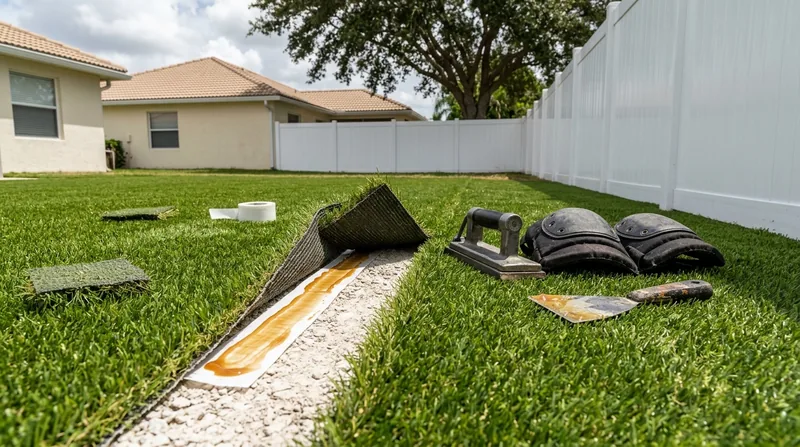




Artificial turf in Port St. Lucie takes a beating from heat, humidity, salt spray off the Indian River Lagoon, and the heavy foot traffic that comes with screened pool cages, paver patios, and the daily wear of family yards across Tradition, Torino, and the older grid neighborhoods near Sandpiper Bay. Turf Repair and Seam Repair in Port St. Lucie addresses the damage that turns a solid installation into a liability: seams that lift or separate, melted spots from window reflections bouncing off stucco, flattened traffic lanes, and edge creep where the turf pulls away from edging or paver borders. These failures are not cosmetic. A lifted seam becomes a trip hazard; a compromised edge lets water and roots invade the base; a melt spot grows if left unattended. We identify the root cause, repair it permanently, and restore the surface to original condition. Whether your turf is five years old or fifteen months old, a seam has failed, or an edge has lifted, we handle it on site with no removal or full replacement needed.
Why Seam and Edge Failure Happens in Port St. Lucie Yards
Port St. Lucie's climate and residential layout create specific stresses on artificial turf seams and edges. The combination of intense afternoon sun, salt-laden humidity, and the freeze-thaw cycles that occur during mild winter dry spells can weaken adhesive bonds over time. Improper base preparation or inadequate compaction during initial installation leaves soft spots that shift under foot traffic, pulling seams apart. Poor drainage around pool cages and patio edges allows water to wick under the turf, destabilizing the base and lifting edges. Reflective glare from windows and stucco walls on homes throughout St. Lucie West and Tradition can concentrate heat on one area of the turf, melting the synthetic fibers and creating weak points that spread. Edge creep happens when the perimeter is not anchored securely to pavers or edging material, especially on slopes or in yards with high water tables that experience settling.
- Seams separate when the adhesive bond fails due to UV exposure, temperature cycling, or movement in the base layer beneath the turf.
- Edges lift when water infiltration destabilizes the base or when the turf was not secured tightly to edging or paver borders during installation.
- Melt spots form when concentrated sunlight or window reflections heat the turf surface above the melting point of the synthetic fibers.
- Flattened lanes develop from repeated foot traffic in the same path, compressing the pile and reducing the cushioning that keeps seams tight.
- Base settlement under pool cages and patio areas creates low spots where water pools, weakening the foundation and pulling seams open.
Catching these problems early prevents them from spreading and keeps repair costs proportional to the damage, not the entire yard.
Key info: In Port St. Lucie, seam failure is most common in yards with poor initial drainage or where the base was not compacted to the full 4 inches required. A seam that lifts in year two or three often signals that the base prep cut corners, and repairing the seam without addressing the base will fail again within months.
For more on how to maintain your turf and prevent costly repairs, see our Turf Cleaning and Pet Odor Treatment service.
How We Repair Seams and Edges in Port St. Lucie
Our repair process begins with a site inspection to identify the failure mode and its cause. We lift the turf along the affected seam or edge, examine the base layer for compaction, moisture, or settling, and determine whether the adhesive bond failed, the base shifted, or drainage is compromised. Once we understand the root cause, we execute the repair: we clean and prepare the seam surfaces, apply new adhesive rated for Florida's heat and humidity, press the seam closed with our seaming iron to create a watertight bond, and test the joint for strength. If the base is soft or saturated, we address that first, either by removing and re-compacting the base layer or by installing additional drainage to prevent the problem from recurring. For edge creep, we re-secure the turf to the perimeter edging or pavers, ensuring the anchor is tight enough to resist movement but not so tight that it stresses the turf fibers.
- We inspect the seam or edge failure on site and identify whether the adhesive, base, or drainage is at fault before beginning work.
- We lift the turf carefully to access the seam or edge, clean the surfaces, and prepare them for new adhesive or re-anchoring.
- We apply commercial-grade seaming adhesive and use a heated seaming iron to fuse the joint and create a permanent, waterproof bond.
- We test the repaired seam for strength and flexibility to confirm it will hold under Florida heat and foot traffic.
- We address the underlying cause, such as base compaction, drainage, or edge anchoring, so the repair does not fail again.
The entire repair typically takes 2 to 4 hours for a single seam, depending on the length and the base work required.
Example: A homeowner in Tradition noticed a lifted seam running across their backyard turf near the pool cage. We inspected and found that the base had settled unevenly, leaving a low spot where water collected after rain. We re-compacted the base, re-applied the seam adhesive, and sealed the joint with our seaming iron. The repair held because we fixed the drainage problem that caused the settlement in the first place.
For comprehensive information on how we install turf correctly the first time, visit our Residential Artificial Grass Installation page.
Turf Repair Methods and When to Use Each
| Repair Method | Description | Best For |
|---|---|---|
| Seam Re-Adhesion | Lift the turf, clean the seam surfaces, apply fresh commercial-grade adhesive, and fuse with a heated seaming iron. | Seams that have separated or are peeling but the turf on both sides is intact and undamaged. |
| Spot Patching | Cut out the damaged area, remove the compromised base, install new base material, and glue a matching patch of turf over the hole. | Melt spots, burn marks, or localized damage smaller than 2 square feet that do not affect seams. |
| Edge Re-Anchoring | Lift the edge of the turf, inspect the base and drainage, re-secure the perimeter to edging or pavers with adhesive or fasteners, and ensure the turf is stretched tight. | Edge creep, lifted corners, or perimeter separation from pavers or landscape edging. |
| Base Repair and Compaction | Remove the turf over the affected area, excavate and re-compact the base to proper depth and density, install drainage if needed, and re-lay the turf. | Soft spots, settling, water pooling under the turf, or seam failure caused by inadequate base preparation. |
| Section Replacement | Remove a section of turf, inspect and repair the base, and install new turf that matches the existing product, pile height, and infill. | Damage larger than 2 square feet, widespread seam failure, or areas where the existing turf cannot be salvaged. |
Each method is selected based on the size, cause, and location of the damage. A proper diagnosis on site ensures we choose the repair that will last and cost the least.
Turf Repair and Seam Repair Cost in Port St. Lucie: What to Expect
Repair costs depend on the type of damage, the size of the area, and whether the underlying base or drainage needs attention. A single seam re-adhesion on a short run might cost $350 to $600, while a larger section repair with base work could reach $1,200 to $2,000. Edge re-anchoring around a pool cage or patio typically runs $400 to $800 depending on the perimeter length and how much of the base needs re-compaction. A spot patch for a melt or burn mark under 2 square feet generally costs $300 to $500. The key variable is what we find when we lift the turf: if the base is sound and the damage is surface-level, the repair is straightforward and affordable. If the base has settled, is waterlogged, or was poorly prepared originally, we must address that to prevent the repair from failing again, which adds cost but ensures durability.
Port St. Lucie's sandy soil and shallow water table mean that drainage problems are common, especially in low-lying areas of Tradition and near the canal system that runs through the city. If water is pooling under your turf or seams are lifting repeatedly, a proper drainage solution is an investment that protects the repair and the turf for years to come.
We always provide a written estimate after an on-site inspection, so you know exactly what the repair will cost and why. Get a free estimate by calling (772) 771-4479 or visiting our pricing page for more detail on repair costs and what factors affect them.
Turf Repair and Seam Repair Near Me: What Port St. Lucie Homeowners Should Know When Hiring
When you need a turf repair company, verify that they have the right tools, materials, and experience for the job. Ask to see a certificate of insurance naming general liability and workers compensation coverage, and request references from recent repair jobs in Port St. Lucie or nearby areas like Fort Pierce, Stuart, or Jensen Beach. A reputable turf installation company will provide a written estimate that names the repair method, the materials to be used, the time required, and the warranty on the work. Avoid installers who offer a verbal quote without inspecting the damage or who promise a repair without understanding whether the base or drainage is at fault. If your turf was installed by another company and the repair is needed because of poor original work, ask the new installer whether they can identify the failure and explain it clearly. Many homeowners in Port St. Lucie's master-planned communities also need to check HOA rules before work begins, especially if the repair involves edging, base materials, or changes to the turf appearance. We handle HOA submittals and work within community standards, and we will walk you through the process.
- Request a certificate of insurance showing general liability and workers compensation coverage before any work starts.
- Ask for a written estimate that includes the repair method, materials, labor, timeline, and warranty on the work performed.
- Check references from recent repair jobs to confirm the installer has experience with seams, edges, and base issues like yours.
- Verify that the installer will inspect the damage on site and identify the root cause before quoting a price.
- If your property is in an HOA community, confirm that the repair meets architectural guidelines and submit for approval if required.
Call us at (772) 771-4479 for a free on-site estimate and to discuss your repair needs. We serve Port St. Lucie and all of the Treasure Coast, and we stand behind our work with a one-year warranty on repairs.
For more information on our services and to schedule your free estimate, visit our contact page.
Turf Repair & Seam Repair in Port St. Lucie: Pricing Guide
| Service | Price | Details |
|---|---|---|
| Single seam re-adhesion | Starting at $350 | Short seam up to 10 feet with sound base; longer seams add $50 to $100 per additional 10 feet |
| Edge re-anchoring | Starting at $400 | Perimeter re-securing around a patio or pool cage; cost increases with length and base compaction needed |
| Spot patch repair | Starting at $300 | Melt or burn damage under 2 square feet; larger patches and base work increase the price proportionally |
| Base repair and seam work | On estimate | Seam failure caused by soft or settled base requires excavation, compaction, and re-adhesion; scope determines final cost |
| Section replacement | On estimate | Damage larger than 2 square feet or widespread seam failure may require turf section replacement with new material |
| Free estimate | Included | On-site inspection and written quote within 24 hours; call (772) 771-4479 with photos or description of damage |
Indicative pricing, the exact cost depends on square footage, finish, and site access. Free personalized estimate within 24h at (772) 771-4479.


